
AI-enabled microbusinesses could significantly accelerate stablecoin adoption as the global gig economy expands, according to Australian cryptocurrency exchange Swyftx.
In its second-quarter industry report, Swyftx projected that the global gig and freelance payments market will reach $2.1 trillion by 2033. Of that, $775 billion is expected to come from AI-native workers—freelancers and solo entrepreneurs leveraging artificial intelligence tools in their operations.
Applying a base-case adoption rate of approximately 33%, Swyftx estimates that $262 billion of this AI-driven cohort’s payment volume could be settled using stablecoins.
“We see the vibe-coding and AI economy as a significant potential tailwind for stablecoin use,” said Pav Hundal, lead market analyst at Swyftx, in an interview with Cointelegraph. “Adoption doesn’t happen just because the technology exists. It happens when the economics are compelling, and the rules are clear. For stablecoins, both of those conditions are now falling into place.”
Stablecoins have already demonstrated strong utility in payments, with their market capitalization doubling over the past two years and transaction volume hitting a record $1.79 trillion in June.
Swyftx highlighted that the smallest businesses—those with fewer than five employees—are leading AI adoption, creating a new wave of globally operating solo founders. These micro-entrepreneurs frequently invoice across borders in small amounts that traditional banking systems are ill-equipped to handle efficiently.
Currently numbering between 6 and 10 million worldwide, this group is projected to grow to 17 million by 2033. Many are highly sensitive to remittance and transaction fees, making them prime candidates for stablecoin adoption.
“A lot of these solo founders are going to be sensitive to remittance and transaction fees. It’s a potentially chunky market for stablecoins,” Hundal added.
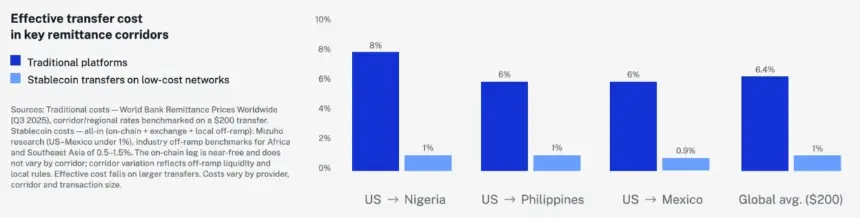

Using stablecoins can save thousands of dollars in annual transfer fees. Source: Swyftx
Swyftx also noted that if its projections materialize, the institutional infrastructure supporting these transactions—including over-the-counter liquidity, custody, and yield services—could generate up to $1.3 billion in revenue by 2033, assuming total service costs of 0.5%.
Traditional cross-border payment systems remain slow and costly, often charging high fees, requiring multi-day settlement periods, and excluding users in more than 50 countries. In contrast, stablecoin transfers via Ethereum Layer-2 networks can reduce fees by 80–90%, saving the average freelancer roughly 86% annually on transfer costs, according to Swyftx.
Looking ahead, the rise of agentic AI—autonomous AI systems conducting transactions—could further boost stablecoin demand, as such agents cannot hold traditional bank accounts and will likely rely on crypto assets for payments.
免责声明:以上内容(如有图片或视频亦包括在内)均为平台用户上传并发布,本平台仅提供信息存储服务,对本页面内容所引致的错误、不确或遗漏,概不负任何法律责任,相关信息仅供参考。
本站尊重他人的知识产权、名誉权等法律法规所规定的合法权益!如网页中刊载的文章或图片涉及侵权,请提供相关的权利证明和身份证明发送邮件到qklwk88@163.com,本站相关工作人员将会进行核查处理回复
