
Bitcoin (BTC) is facing a critical test this week as it approaches the closely watched U.S. Consumer Price Index (CPI) report on Tuesday, with analysts divided on whether the cryptocurrency can hold support in the $60,000–$63,000 range.
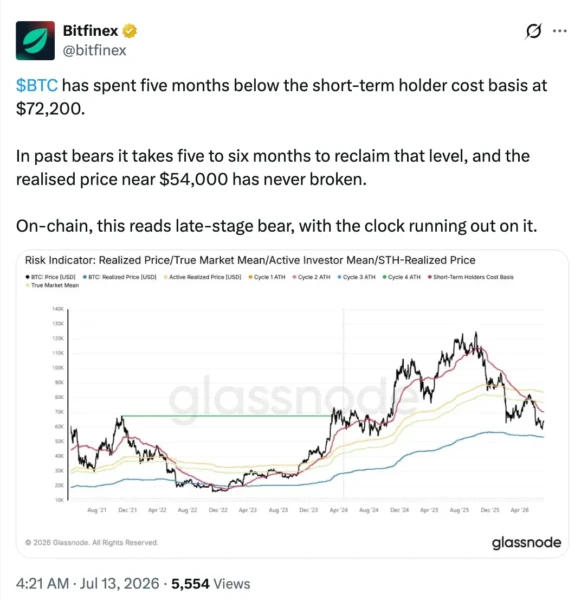
Bitfinex analysts described Bitcoin’s current on-chain structure as indicative of a “late-stage bear” market, despite consistent weekly accumulation by long-term holders. According to their latest data, long-term holders are acquiring between 50,000 and 100,000 BTC per week and now control a record 14.8 million BTC—approximately 75% of the total supply. However, Bitfinex warned that the $60,000–$63,000 price shelf lacks strong flow support, calling potential ETF outflows “the biggest risk” ahead of the CPI release.

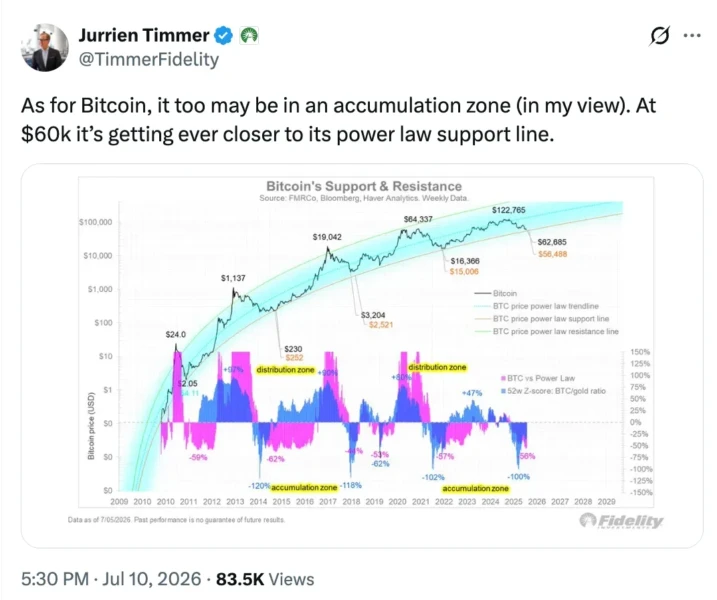
Fidelity’s global macro director, Jurrien Timmer, echoed cautious optimism, suggesting Bitcoin may be entering an “accumulation zone.” His power-law model—which plots Bitcoin’s historical price trajectory on a logarithmic scale—currently indicates key support levels near $58,000 and $62,685. The model has historically aligned with major cycle lows, such as the 2018 bottom at $3,204 (vs. $2,521 projected) and the 2022 low at $16,366 (vs. $15,006 projected).
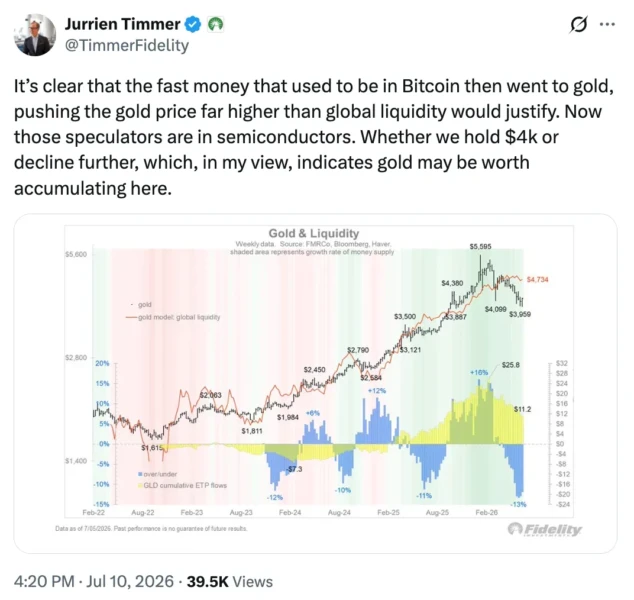
Timmer also noted a broader shift in speculative capital, observing that “fast money” has rotated from Bitcoin to gold and now into semiconductors—a trend that could limit near-term upside for crypto assets.
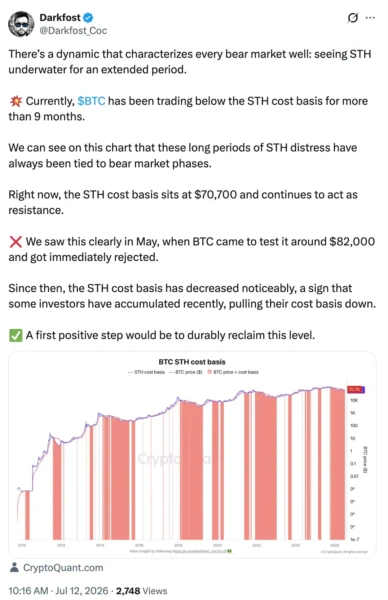
Adding to the bearish signals, CryptoQuant analyst Darkfost highlighted that Bitcoin’s short-term holder (STH) cost basis remains around $70,700. With BTC trading below this level for over nine months, Darkfost emphasized this prolonged period underwater as a hallmark of bear markets.
At press time, Bitcoin was trading at $63,125, down more than 1% over the past 24 hours. Retail sentiment on Stocktwits shifted from “neutral” to “bearish,” accompanied by low discussion volume.
The upcoming CPI data is pivotal: hotter-than-expected inflation could prompt the Federal Reserve to maintain higher interest rates longer, reducing appeal for risk assets like Bitcoin. Conversely, softer inflation may boost liquidity expectations and fuel inflows into crypto. Bitfinex stressed that Bitcoin is now more closely tracking U.S. Treasury yields than traditional hedges like gold or oil, underscoring its growing sensitivity to macroeconomic policy.
免责声明:以上内容(如有图片或视频亦包括在内)均为平台用户上传并发布,本平台仅提供信息存储服务,对本页面内容所引致的错误、不确或遗漏,概不负任何法律责任,相关信息仅供参考。
本站尊重他人的知识产权、名誉权等法律法规所规定的合法权益!如网页中刊载的文章或图片涉及侵权,请提供相关的权利证明和身份证明发送邮件到qklwk88@163.com,本站相关工作人员将会进行核查处理回复
